

April 9, 2026
5 tools compared: trial-to-paid analytics for SaaS teams

On this page
Why trial signups don't tell the whole story
Your trial signup rate looks healthy. Activation is trending upward. But when it's time to report to the executive team, you're stuck explaining why only 12% of those signups turned into paying customers—and worse, you can't say which campaigns or channels delivered the trials that actually converted.
This is the gap that kills SaaS growth. You're optimizing for volume (more signups) when you should be optimizing for quality (signups that convert and stick). You're celebrating MQLs when the board wants to see pipeline contribution. And you're running blind on which visitor behaviors predict someone who'll pull out their credit card versus someone who'll ghost after day three.
The problem isn't effort or intent. It's that most teams are stitching together tools that were never designed to connect the dots between anonymous website visitor, engaged trial user, and revenue-generating customer. Google Analytics shows traffic. Your product analytics shows feature adoption. Your CRM tracks deals. But none of them talk to each other in a way that answers the question that actually matters: which marketing efforts drive trials that become valuable customers?
According to a 2026 report from ChartMog, the median B2B SaaS free trial conversion rate sits at 8%, though opt-out trials (credit card required) can hit 50-60%. The gap between average and top performers is massive—and it's not random. Companies that connect visitor behavior to revenue outcomes consistently outperform those flying blind.
What visitor behavior intelligence actually means
Visitor behavior intelligence is the practice of tracking and analyzing user interactions across the entire customer journey—from the first anonymous page view through trial signup, product engagement, and ultimately to paid conversion and lifetime value. It's not just session recordings or heatmaps. It's a unified view that connects marketing attribution, product analytics, and revenue outcomes into a single timeline.
For SaaS teams dealing with trial-to-paid conversion challenges, this means being able to answer questions like:
- Which blog posts or landing pages attract visitors who actually convert to paid plans?
- Do users who arrive from organic search convert at higher rates than paid ads?
- Which in-product features, when adopted during trial, predict paid conversion?
- What's the average time from first visit to paid conversion for your highest LTV customers?
- Which keyword or campaign drove that $50k annual contract that closed last month?
The best platforms don't just track these data points—they connect them. You can see that a visitor arrived via a Google search for "revenue attribution software," read two comparison articles, signed up for a trial, connected their Stripe account within 24 hours, invited three team members, and upgraded to a paid plan six days later. Then, critically, you can see that pattern repeated across dozens or hundreds of similar customers, giving you a playbook to optimize.
The 5 tools compared: what they do and where they fit
We evaluated five platforms that SaaS teams commonly consider when tackling the trial-to-revenue visibility problem. Each takes a different approach, with distinct strengths and trade-offs.
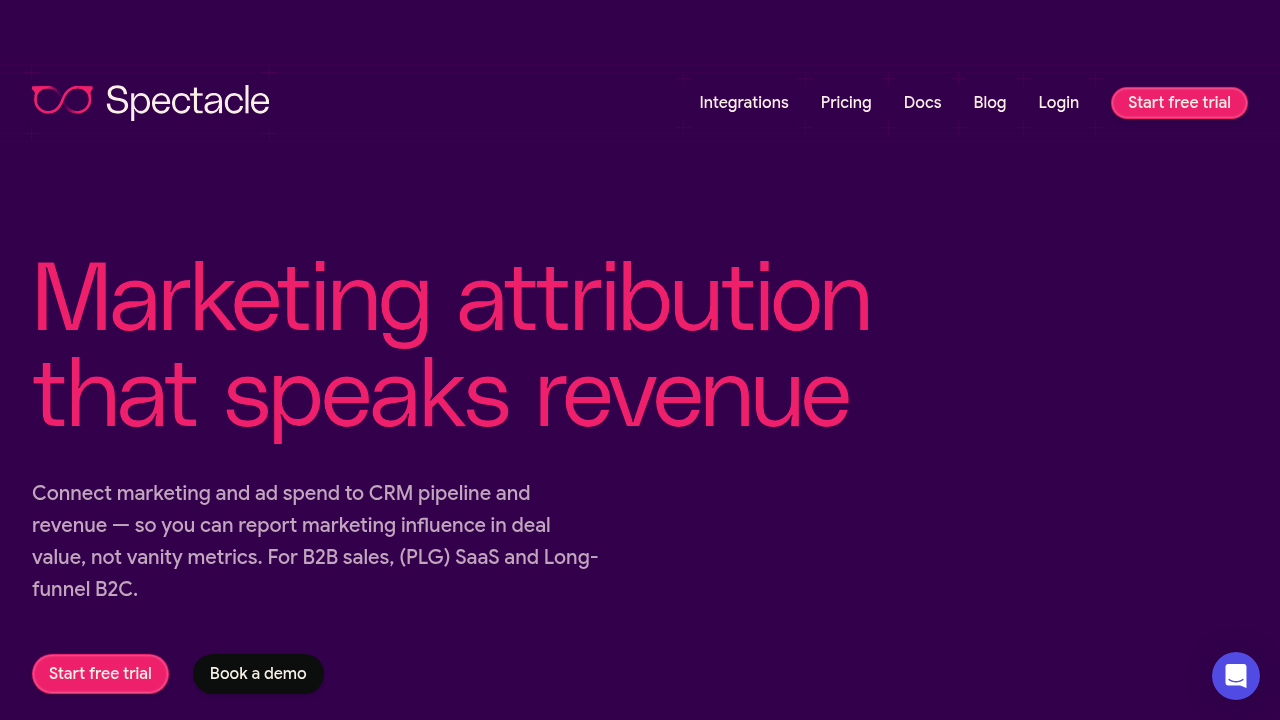
Spectacle: revenue-first attribution for SaaS
Spectacle is built specifically for SaaS and subscription businesses that need to connect marketing spend to actual revenue, not vanity metrics. The platform tracks the full customer journey—from anonymous website visitor through trial signup, product engagement, and paid conversion—and attributes revenue back to the original marketing source.
What sets Spectacle apart is company-level attribution. Instead of tracking individual leads in isolation, it merges touchpoints across multiple people at the same company, giving you a realistic view of how B2B buying committees interact with your product. A marketing manager might discover you through a blog post, a product lead might sign up for a trial, and a CFO might be the one who ultimately approves the purchase. Spectacle connects those dots.
The platform integrates directly with revenue sources like Stripe, Chargebee, and major CRMs (HubSpot, Pipedrive, Salesforce), as well as ad networks (Google Ads, LinkedIn, Facebook). This means you can see not just which campaigns drive trial signups, but which ones drive paid conversions and how much revenue they generate over time.
Spectacle also includes funnel tracking that spans from first click through to power user status, identifying exactly where high-intent visitors drop off. You can filter funnels by source, keyword, ad group, or campaign to see which acquisition channels deliver users who actually complete the journey to paid customer.
The anonymous visitor reveal feature identifies companies visiting your website even before they fill out a form, letting you see which high-intent accounts are researching your product.
Best for: B2B SaaS teams with sales-led or product-led growth motions who need to prove marketing's contribution to pipeline and revenue, and want to optimize ad spend based on LTV rather than cost per trial.
Pricing: Starts at $99/month with a free trial available.
Key strengths:
- Direct Stripe and revenue system integration for true revenue attribution
- Company-level attribution (not just lead-level)
- Fast setup compared to enterprise attribution tools
- Tracks trial-to-paid and beyond to LTV
- Built specifically for SaaS/subscription business models
Considerations:
- Less depth in session replay and qualitative behavior analysis than specialized product analytics tools
- Focused on B2B and long sales cycles; may be overkill for simple B2C subscription products
Mixpanel: event-driven product analytics
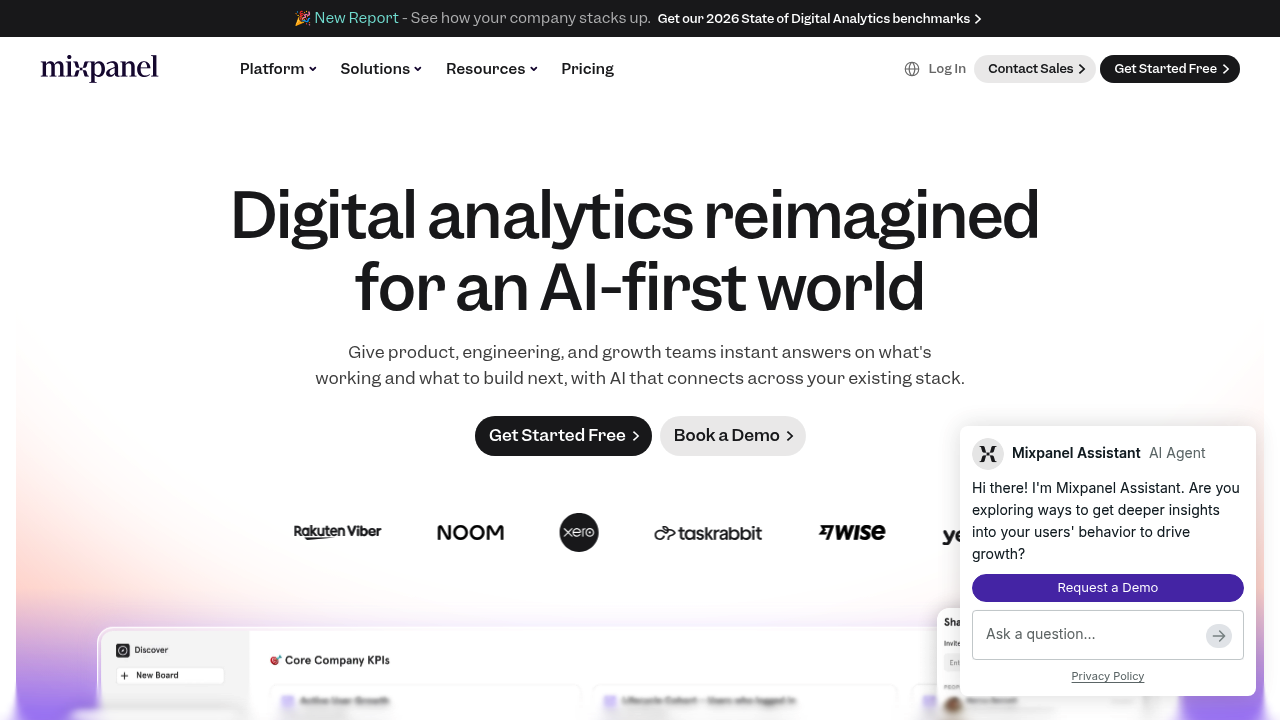
Mixpanel is one of the leading product analytics platforms, focused on event-based tracking and user journey analysis. It excels at showing you what users do inside your product—which features they adopt, how often they return, and where they drop off in your onboarding flow.
The platform's strength lies in its flexibility and depth of behavioral analysis. You can define custom events (like "connected first data source" or "invited team member"), then build funnels, cohorts, and retention reports to understand which behaviors correlate with outcomes like paid conversion or long-term engagement.
Mixpanel charges based on monthly tracked events, which can work well for businesses with high user counts but moderate per-user activity. The free tier offers up to 20 million events per month, making it accessible for early-stage companies. Paid plans start around $25/month for basic usage and scale with event volume.
Where Mixpanel shines is in segmentation and cohort analysis. You can easily compare how users who adopted feature X during their trial differ from those who didn't, then track their retention and behavior over weeks or months.
Best for: Product-led SaaS companies that need deep visibility into in-app user behavior and want to optimize onboarding, feature adoption, and retention.
Pricing: Free up to 20M events/month; paid plans start around $25+/month based on event volume.
Key strengths:
- Powerful event tracking and custom funnel creation
- Strong cohort and segmentation capabilities
- Intuitive interface and fast implementation
- Good for identifying which in-product behaviors predict conversion
Considerations:
- Limited native marketing attribution (doesn't track pre-signup ad campaigns well)
- No built-in revenue tracking—requires manual integration with billing systems
- Doesn't identify anonymous visitors or track pre-trial website behavior effectively
Amplitude: behavioral analytics at scale
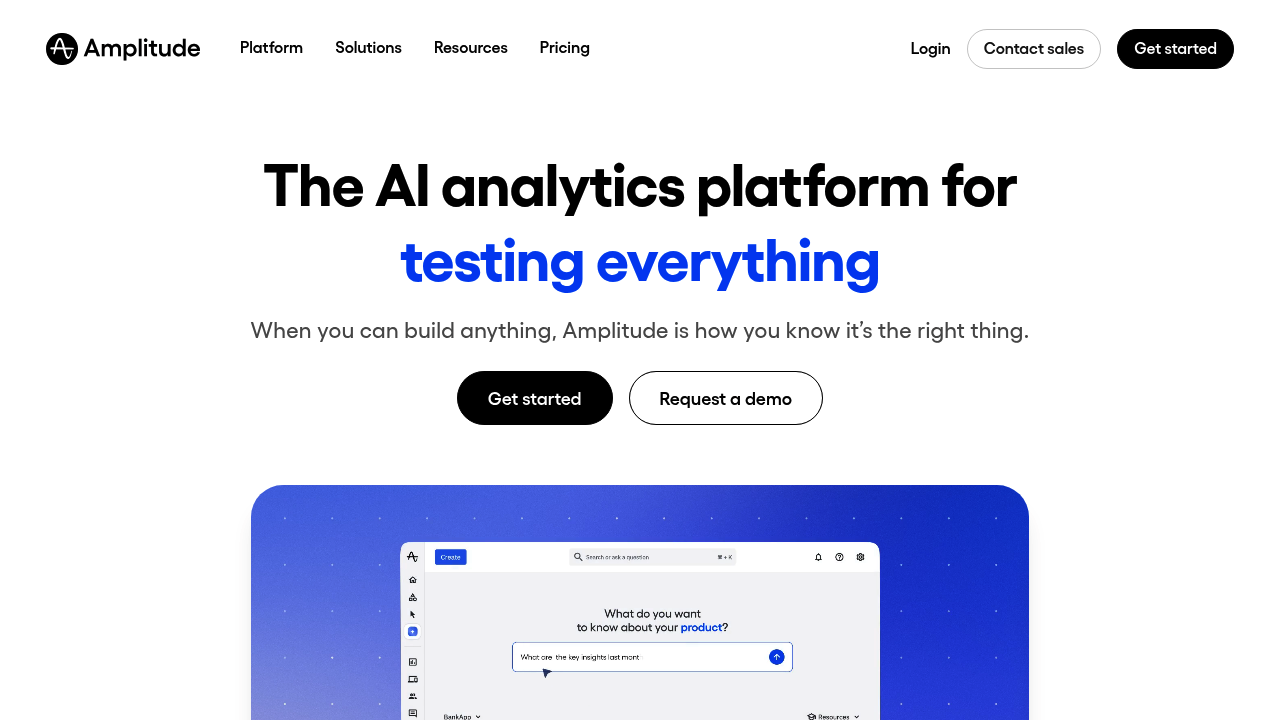
Amplitude positions itself as the analytics platform for product-led growth companies. Like Mixpanel, it focuses on understanding user behavior within your product, but it's particularly strong in predictive analytics and experimentation.
Amplitude charges based on Monthly Tracked Users (MTUs) rather than events. The Starter plan is free for up to 10 million events per month, though with limited chart capabilities. Paid plans (Plus and above) start around $49-100+/month depending on scale, with pricing rising significantly at higher volumes.
Where Amplitude differentiates itself is in behavioral cohort analysis and identifying patterns across large user bases. The platform can automatically surface insights like "users who complete action X within their first session are 3x more likely to convert" without you having to manually construct every query.
Research from Mixpanel suggests that products with well-defined activation metrics see up to 3x higher trial-to-paid conversion rates, and Amplitude makes it easier to identify those activation moments through its data-driven approach.
Best for: Mid-market to enterprise product-led SaaS companies with large user bases who need sophisticated behavioral analysis and experimentation capabilities.
Pricing: Free Starter plan (10M events/month with limitations); paid plans start around $49-100+/month based on MTUs.
Key strengths:
- Advanced behavioral cohort analysis
- Predictive analytics and automated insight generation
- Strong experimentation and A/B testing capabilities
- Scales well for large data volumes
Considerations:
- Pricing can become expensive at scale for MTU-based model
- Like Mixpanel, weak on marketing attribution and pre-signup journey tracking
- Steeper learning curve than some alternatives
- Still requires external tools to connect product behavior to revenue outcomes
HubSpot Marketing Hub: all-in-one with attribution reporting
HubSpot is an all-in-one CRM, marketing automation, and sales platform that includes attribution reporting in its Professional and Enterprise tiers. For teams already using HubSpot, the native attribution features can provide visibility into which marketing activities drive contacts, deals, and revenue.
HubSpot's attribution reports track touchpoints like page views, form submissions, email clicks, ad clicks, and sales calls. The platform offers multiple attribution models—first-touch, last-touch, linear, U-shaped, W-shaped (crediting first touch, lead creation, and opportunity stages), and full-path multi-touch attribution.
You can create revenue attribution reports that show how much closed-won revenue is attributed to specific campaigns, content pieces, or channels. For example, you could see that a particular blog post generated $45,000 in closed revenue over the past quarter by analyzing all deals where contacts engaged with that content.
The challenge is that HubSpot's attribution is strongest for contacts and activities that happen within the HubSpot ecosystem. It tracks website visits via its tracking code and can connect ad clicks from platforms like Facebook, LinkedIn, and Google—but the data quality depends heavily on proper implementation and cookies being accepted.
Best for: Teams already using HubSpot as their CRM and marketing automation platform who want attribution reporting without adding another tool.
Pricing: Attribution reporting requires Marketing Hub Professional (starts around $800/month) or Enterprise; full pricing varies based on contact count.
Key strengths:
- Unified platform—no need to integrate separate tools
- Multiple attribution models including W-shaped and full-path
- Native CRM integration shows revenue attribution by campaign
- Strong for teams with established HubSpot workflows
Considerations:
- Requires Professional or Enterprise tier, which can be expensive for smaller teams
- Attribution quality depends on implementation and cookie acceptance
- Less granular for in-product behavior during trial phase
- Best as part of broader HubSpot adoption, less valuable as standalone attribution solution
Ruler Analytics: call tracking meets digital attribution
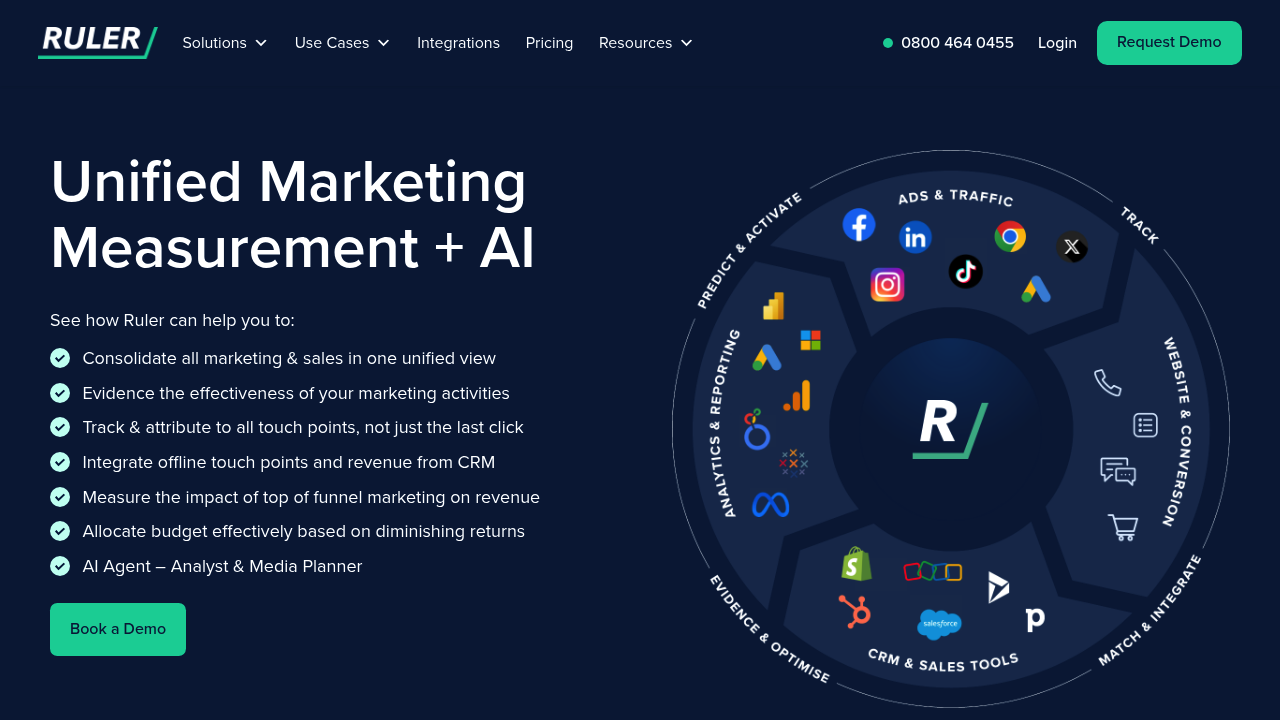
Ruler Analytics is a marketing attribution platform designed for businesses with inbound sales motions that include phone calls and form submissions. It connects marketing sources to CRM outcomes, with a particular strength in tracking offline conversions.
The platform tracks website visitor sessions and attributes them to marketing sources (paid ads, organic search, referral, direct), then maintains that connection when visitors convert through forms or phone calls. When a lead progresses through your CRM and closes as won, Ruler attributes that revenue back to the original marketing touchpoint.
Ruler offers seven attribution models including first-touch, linear, position-based, time-decay, and data-driven attribution. The platform integrates with Google Ads, Facebook, LinkedIn, and major analytics tools, allowing you to push conversion and revenue data back to those platforms for optimization.
Where Ruler stands out is for B2B companies with significant phone-based conversions. The call tracking feature provides dynamic phone numbers that link calls to specific campaigns or keywords, closing the loop on channels that drive offline inquiries.
Best for: B2B SaaS with sales-led or hybrid motions that rely on demo requests, phone calls, and inbound sales conversations—especially if call tracking is critical.
Pricing: Starts around $300/month; pricing scales with features and call tracking volume.
Key strengths:
- Strong call tracking and offline conversion attribution
- Seven attribution models for flexible analysis
- Solid CRM integration (Salesforce, HubSpot, Pipedrive)
- Good for bridging marketing campaigns to sales-qualified opportunities
Considerations:
- Less focused on in-product trial behavior analytics
- Primarily for lead generation and sales-assisted models; less relevant for pure self-serve PLG
- Call tracking features may be unnecessary for fully digital trial-to-paid motions
Feature comparison: what each platform tracks
Feature | Spectacle | Mixpanel | Amplitude | HubSpot | Ruler Analytics |
Anonymous visitor tracking | ✓ | Limited | Limited | ✓ | ✓ |
Marketing attribution (pre-signup) | ✓ | Limited | Limited | ✓ | ✓ |
In-product behavior tracking | ✓ | ✓✓ | ✓✓ | Limited | Limited |
Trial-to-paid funnel tracking | ✓ | ✓ | ✓ | ✓ | Limited |
Revenue attribution | ✓✓ | Manual | Manual | ✓ | ✓ |
LTV tracking | ✓ | Manual | Manual | ✓ | ✓ |
Company-level attribution | ✓ | - | - | Limited | Limited |
Anonymous company identification | ✓ | - | - | - | Limited |
Call tracking | - | - | - | - | ✓✓ |
Session replay | - | - | - | - | - |
Multi-touch attribution models | ✓ | - | - | ✓ | ✓✓ |
Direct billing integration (Stripe, etc.) | ✓ | - | - | Limited | Limited |
Audience sync to ad networks | ✓ | - | - | ✓ | ✓ |
Note: ✓✓ indicates a core strength; ✓ indicates solid support; Limited indicates partial functionality; - indicates not a primary feature.
How to choose: matching tools to your business model
The right tool depends on your SaaS motion, team structure, and where your biggest visibility gaps exist.
If you're product-led growth (PLG) with self-serve trials, and your primary challenge is understanding which in-product behaviors predict paid conversion, Mixpanel or Amplitude give you the deepest insight into feature adoption, onboarding flow, and activation moments. Pair one of them with a lightweight attribution layer (like UTM tracking in GA4 or a specialized tool) to connect acquisition source to conversion.
However, if you also need to track which marketing campaigns and keywords drive the trials that convert—and you want to optimize ad spend based on revenue, not just trial volume—Spectacle provides that end-to-end view without requiring you to stitch together multiple platforms.
If you're sales-led or hybrid (trials followed by sales conversations), you need attribution that connects marketing through to closed deals in your CRM. HubSpot (if you're already all-in on their ecosystem) or Ruler Analytics (especially if phone calls are a key conversion point) can bridge that gap. Spectacle is also well-suited here, particularly for tracking both self-serve trial conversions and sales-assisted deals with company-level attribution.
If you're an early-stage startup on a tight budget, start with the free tiers of Mixpanel (20M events/month) or Amplitude (Starter plan) to understand in-product behavior. Combine that with native analytics tools (GA4 for website traffic, Stripe dashboard for revenue) and manual analysis. As you scale and the cost of guessing grows, invest in a unified platform.
If your executive team demands clear ROI reporting and you're tired of explaining why signups don't equal revenue, Spectacle or a robust implementation of HubSpot attribution (if you're already a HubSpot customer) will give you the revenue-level reporting that satisfies the C-suite. Both can show actual dollars attributed to campaigns, not just lead counts.
If you operate in B2B with multi-stakeholder buying committees, standard lead-level attribution will mislead you. You need company-level tracking that merges touchpoints across multiple people. Spectacle's company journey feature is built specifically for this, showing how different stakeholders interact with your content and product before a deal closes.
Implementation realities: setup time and technical effort
These platforms vary significantly in how quickly you can get actionable insights.
Spectacle emphasizes fast setup—connecting your website tracking, ad networks, and revenue sources in a few clicks rather than weeks of data engineering. Most teams get their first attribution reports within days. The platform handles identity resolution (matching anonymous visitors to known users) automatically.
Mixpanel and Amplitude require more upfront instrumentation effort. You'll need to define your event schema, implement tracking code for each meaningful product interaction, and often involve engineering to ensure data quality. Budget 2-4 weeks for proper implementation, though you can get basic tracking running faster. The benefit is once it's set up, you have incredible flexibility to analyze any behavior pattern.
HubSpot is easiest for teams already using the platform—attribution reporting is a feature you turn on rather than a new system to implement. But if you're not a HubSpot customer, adopting it for attribution alone is a massive commitment (migration effort, cost, learning curve).
Ruler Analytics typically requires 1-2 weeks to implement, including setting up call tracking numbers, integrating with your CRM, and configuring attribution models. The call tracking component adds complexity but also value for businesses where phone conversations drive revenue.
What the data says: trial conversion benchmarks
Context matters when evaluating whether your current trial-to-paid rate is a problem worth solving with better analytics.
According to 2026 data compiled by IdeaProof, opt-in free trials (no credit card required) in B2B SaaS convert at 15-25% on average, while opt-out trials (card required) can hit 50-60%. Freemium-to-paid conversion is much lower, typically 2-5%.
The data also reveals that activated users—those who reach the "aha moment" within their first session—convert at 3-5x the average rate. This is exactly the kind of insight that product analytics like Mixpanel or Amplitude excel at surfacing, and why connecting behavioral tracking to conversion outcomes is so valuable.
A 2026 SaaS Hero report found that the top 10% of B2B SaaS companies convert website visitors to leads at 8-15%, while average performers struggle at 1.5-2.5%. The gap exists throughout the funnel. Top performers also maintain trial-to-paid conversion rates of 25%+ compared to the 10-15% typical range.
The difference isn't random luck. It's the result of measurement systems that identify which channels, content, and product experiences drive quality—then systematically optimizing toward those patterns.
The hidden cost of incomplete data
The tools compared here range from free tiers to several hundred dollars per month at the low end, up to thousands for enterprise plans. But the real cost isn't the subscription price—it's the opportunity cost of making decisions without complete data.
When you can't connect marketing spend to revenue outcomes, you optimize for the wrong metrics. You might kill a Google Ads campaign that's driving high-LTV customers because its cost-per-trial looks expensive. You might double down on a content channel that generates lots of signups but terrible conversion rates.
You build product features that boost engagement metrics but don't move users toward paid conversion. You design onboarding flows based on gut feel instead of data showing which paths lead to revenue.
A mid-sized SaaS company spending $50,000/month on paid acquisition might waste $15,000-20,000 of that on channels and campaigns that look productive (lots of trials) but don't actually generate customers. Over a year, that's $180,000-240,000 in wasted spend—far more than the cost of the analytics tools that would reveal the problem.
The math is even more stark when you consider customer lifetime value. If you can identify that users who adopt feature X during trial have 2.5x higher LTV, you can redesign onboarding to get more users to that moment. A 20% improvement in the mix of customers (more high-LTV, fewer low-LTV) compounds dramatically over time.
Bringing it together: building your trial intelligence stack
For most SaaS teams, the optimal solution isn't choosing one tool—it's assembling a lightweight stack that covers the three critical layers:
Layer 1: Marketing attribution (pre-trial)—tracking which campaigns, content, and channels drive trial signups. Spectacle, HubSpot, or Ruler Analytics fill this role.
Layer 2: Product behavior (during trial)—understanding which features users adopt, which workflows they complete, and which actions predict paid conversion. Mixpanel or Amplitude excel here.
Layer 3: Revenue connection (post-conversion)—linking all of the above to actual revenue outcomes, LTV, and expansion. This is where most setups break down, requiring manual exports and spreadsheet gymnastics.
The most elegant solution is a platform that covers all three layers natively, which is what Spectacle provides for SaaS and subscription businesses. You get marketing attribution, in-product event tracking, and direct revenue integration without stitching together multiple tools.
Alternatively, you can build a stack: Mixpanel/Amplitude for product analytics + Segment for data routing + a CRM with revenue reporting + manual analysis to connect the dots. This works but requires more setup effort and ongoing maintenance.
The key is ensuring you can answer the question that matters: which marketing efforts are driving trials that turn into valuable, long-term customers? If your current setup can't answer that clearly, you've found the gap worth fixing.
What to do next
Start by auditing your current visibility. Open your analytics dashboard and try to answer these questions:
- Which specific blog post or landing page led to your highest-value customer from last quarter?
- What was the full journey—from first visit through trial signup to paid conversion—for that customer?
- Which in-product features did they adopt during trial?
- How many days elapsed from first website visit to paid conversion?
- What's the trial-to-paid conversion rate for users who arrived from organic search versus paid social?
If you can't answer most of these questions with your current tools, you have a visibility gap that's costing you revenue.
For teams currently using disconnected tools (GA4 for traffic, a product analytics tool for behavior, CRM for deals), the path forward is either building the integrations to connect them or adopting a unified platform.
For early-stage teams starting from scratch, the fastest path to insight is implementing event tracking in your product (Mixpanel free tier works well) and tracking UTM parameters religiously through to conversion. As you grow, add a dedicated attribution platform when the investment in ad spend and team time justifies it.
For established SaaS companies already spending significantly on acquisition, incomplete attribution is an expensive problem that gets worse as you scale. The sooner you implement end-to-end tracking, the sooner you can shift budget from campaigns that drive volume to campaigns that drive revenue.
Latest insights